
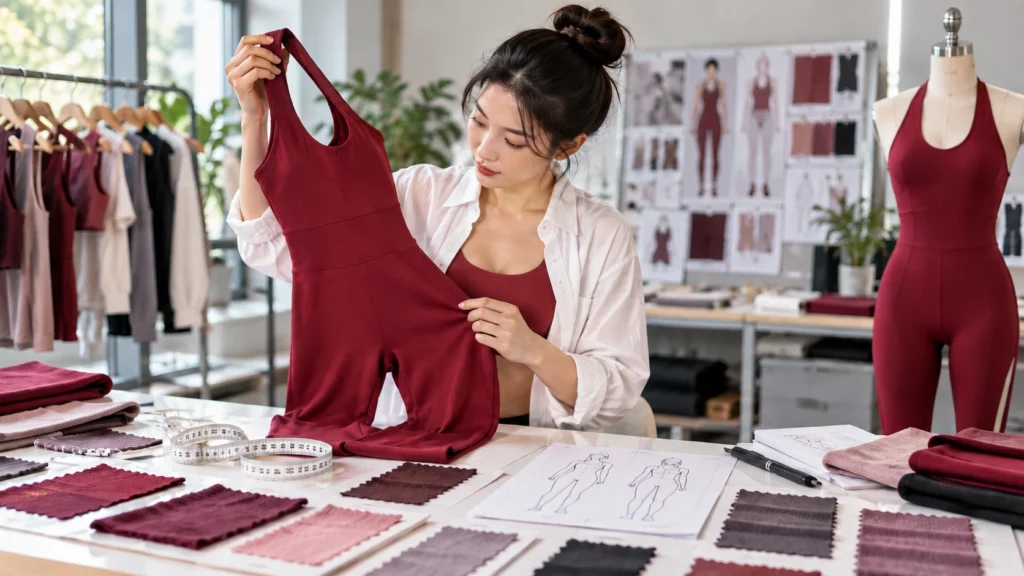
For an activewear brand, the right fabric is not simply the softest or stretchiest option on a swatch card. It is the material and knit construction that delivers the intended hand feel, coverage, support, moisture behavior, and appearance after the garment is made and worn. A reliable choice starts with the product brief and ends with factory testing, not with a fiber name alone.
Nylon/spandex and polyester/spandex are the two core development paths for yoga and performance apparel. The better choice depends on activity, garment architecture, weight, stretch and recovery targets, and whether a manufacturer can translate those targets into repeatable samples and bulk production. This guide shows how to make that decision with Xuanfei’s yoga clothing collection as a manufacturing context.
Start with the Product Brief, Not the Fiber Name
Before comparing nylon with polyester, define what the garment must do. A studio legging may need a soft face, stable four-way stretch, squat coverage, and moderate shaping. A high-sweat training top may prioritize moisture transport, rapid drying, low weight, and color stability. A compression short or bra may need firmer fabric and higher recovery so support does not disappear after wear.
Yoga, Studio, and Low-Impact Styles
Yoga products expose flaws through deep flexion, twisting, and close body contact. Test at the actual garment stretch, not only in a relaxed swatch. A soft nylon blend still needs enough density and recovery to stay opaque at the hip, seat, and knee. Engineered mesh can add ventilation without making the body too sheer.
High-Sweat and High-Load Styles
Running and training products face more sweat, abrasion, and laundering. Polyester-based constructions can make sense when fast drying and color retention are central, while nylon can help when softness and abrasion resistance matter. Make the decision on the garment sample because yarn, knit density, finish, and color change the result.
Nylon/Spandex vs Polyester/Spandex
Spandex supplies elastic extension, but the base fiber, yarn arrangement, knit structure, and finishing process determine how that stretch feels and lasts.
Nylon/Spandex
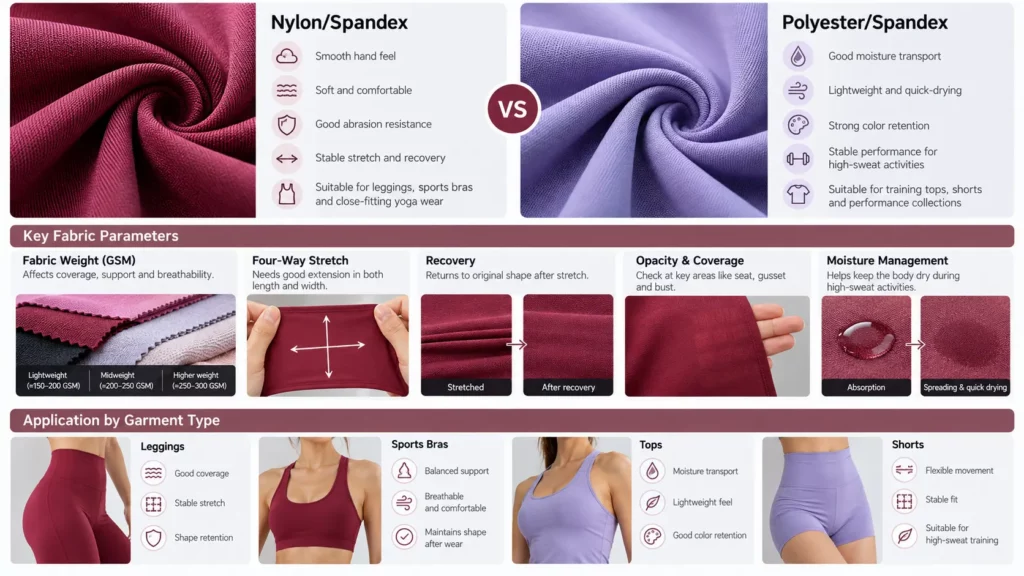
Nylon/spandex is often selected for leggings, sports bras, and close-fitting yoga pieces because it can provide a smooth hand and a flexible, body-hugging feel. It is a candidate when comfort, abrasion resistance, and recovery must coexist. Check pilling, shine at high strain, even recovery across panels and sizes, and whether coverage survives wear and washing.
Polyester/Spandex
Polyester/spandex is commonly considered for high-sweat tops, shorts, and training collections where moisture transport, lightness, color retention, and drying speed matter. Performance still depends on yarn size, knit openness, and finishing. Test the actual color and finish: a dense dark version may behave differently from a pale lightweight version of the same nominal blend.
Blends, Yarns, and Knit Construction
A fiber percentage is a starting point, not a specification. The same blend can feel and perform differently when yarn counts, spandex tension, stitch density, or finishing changes. In seamless development, gauge and knit zones can place support at a waistband, breathability at the back, or flexibility at the crotch and knee. Put those zones in the tech pack and approve them on a garment, not just a cutting.
Use Weight, Four-Way Stretch, and Recovery as a System
Weight is useful only when tied to the garment job. A lightweight fabric may improve ventilation but lose coverage when stretched. A heavier fabric can support opacity yet feel warm or restrictive. Record GSM consistently, then evaluate it with garment dimensions, stitch density, and construction.
- Weight and coverage. Compare relaxed and stretched opacity at the seat, gusset, bust, and waistband. Do not approve a weight by number alone.
- Four-way stretch. Measure crosswise and lengthwise extension. Yoga leggings need movement in both directions; a supportive bra may limit one direction.
- Record return after a controlled stretch and repeated cycles. Poor recovery shows as bagging, a rolling waistband, or a pushed-out knee.
- Compression and comfort. Compression is created by fabric, pattern, and grading. Confirm pressure and ease on the body or fit form, not from fiber content alone.
Performance Tests Before Bulk Approval
A buyer’s guide is useful only when it leads to a test plan. Ask for a sample in the intended color, weight, and construction, then test the finished garment through market stresses. Record the fabric lot, finish, size, and wash or wear condition so the result can be compared at production.
- Moisture management. Observe spread, face wetness, and drying time. Compare body fabric with mesh and binding materials.
- Evaluate airflow at the back, underarm, gusset, and waistband. Pair a dense opaque body with engineered mesh where needed.
- Pilling and abrasion. Rub inner thigh, underarm, and bag-strap zones. Record surface fuzz and visual change, not only pass/fail.
- Check shade change and transfer after washing, perspiration, and rubbing. Test the actual production color.
- Coverage under strain. Inspect squat, hinge, reach, and seated positions, especially at seams or knit transitions where tension concentrates.
From Lab Swatch to Production-Ready Garment
The development partner should connect material selection to the machine and process that will make the garment. Xuanfei describes an OEM flow covering yarn selection, knitting, dyeing, cutting, sewing, quality control, packaging, and logistics. The chosen yarn and weight can require different stitch density, tension, finishing, or panel handling. A swatch that looks right can fail when shaped around a body or joined to another component.
For seamless activewear, the factory can program different thicknesses and elastic properties into one garment, such as a supportive waistband or breathable back zone. The loop should include a first sample, fit and performance notes, a revised sample, and pre-production confirmation using the approved yarn, color, gauge, and construction. Xuanfei’s development and OEM/ODM process is relevant because capability is part of the material decision.
What to Ask a Manufacturing Partner
A supplier review should test whether a partner can repeat the approved result, not just send an attractive first sample. Ask for the following before bulk:
- A traceable material brief. Record composition, GSM target, stretch and recovery, finish, color, intended garment, and acceptable variation.
- A sample iteration plan. Confirm who owns fit comments, how revisions are logged, and when a new fabric or knit program is required.
- Testing at the garment stage. Request stretch, wash, pilling, color, and coverage checks on the actual style, not only generic mill data.
- Capacity and quality controls. Check machine type, gauges, production scale, in-line checks, and final inspection. Xuanfei states that it operates 60+ seamless knitting machines, has 100+ skilled workers, and performs two inspections before shipment; ask any supplier to substantiate such claims with current records.
- A commercial fit. Clarify sample timing, MOQ, color minimums, packaging, and RFQ inputs. Xuanfei publishes trial MOQs of roughly 100-200 pieces per style, subject to design.
For brands building a line rather than buying fabric by the yard, these checks reduce the risk of approving a material that cannot be reproduced across colors, sizes, or seasons. They also create a shared language between design, technical development, and factory quality.
Conclusion
Choose activewear fabric by matching fiber, weight, stretch, recovery, coverage, and moisture behavior to the garment’s real use. Nylon/spandex often supports a soft, resilient yoga hand; polyester/spandex can be a strong route for fast-drying performance styles. Neither wins by default. The reliable decision comes from a controlled sample and a manufacturing partner that can reproduce the approved knit, color, fit, and test result at scale. For brands that need a seamless development path, Xuanfei presents the combined product and factory context needed to move from brief to sample.
FAQs
Is nylon/spandex always better for yoga leggings?
No. It can offer a soft hand and recovery, but the result depends on density, weight, finish, color, and pattern. Test opacity and recovery on the finished legging.
What does four-way stretch mean for a buyer?
It means the fabric extends lengthwise and crosswise. The amount of stretch and recovery still need to be measured against the garment’s fit and support target.
How should a factory test colorfastness?
Use the intended production color and evaluate shade change and transfer after washing, perspiration, and rubbing. Record the conditions and fabric lot so approvals are comparable.
What should be included in an activewear fabric RFQ?
Include garment type, fiber blend, GSM target, stretch and recovery, coverage or compression goal, color references, quantity, size range, testing needs, and tech pack or sample information.
To request a fit check or RFQ, send the garment type, target material or blend, GSM range, dimensions or tech pack, color needs, quantity, and the performance tests that matter to your line. You can contact the technical team with those details so the first sample is built around a measurable brief.