

For a yoga-wear brand, the right manufacturing method is a product decision before it is a factory decision. Seamless knitting can create a close, low-friction base with engineered zones, while cut-and-sew construction gives a pattern maker more freedom over panels, linings, trims, and fabric combinations. Neither method is automatically superior. The better choice depends on the fit you want, how much compression the garment must deliver, the structural details it needs, the range of fabrics and graphics, development economics, the product category, and the launch date. Xuanfei supports both seamless and cut-and-sew production, so the brief can determine the route for each style.
What changes when the manufacturing method changes
Seamless yoga wear is knitted as a shaped tube or near-finished garment, with stitch changes building contours, ventilation, and stretch into the fabric. This reduces the number of cut panels and sewn joins. A cut-and-sew style starts with a two-dimensional pattern: fabric is laid, cut into panels, assembled, and finished with seams, elastic, bindings, pockets, or other components. That process creates more physical junctions, but it also gives the development team direct control over each panel and component.
The practical question is not whether a garment has seams. It is where the garment needs engineered behavior and where it needs construction freedom. Use the same criteria for both methods so a visually attractive sample does not hide a poor production fit.
Compare both methods on the same decision framework
Fit and movement
Seamless fit: A knitted structure can follow the body with fewer side or back seams and can place stretch, rib, mesh, or body-mapped zones into the fabric. This is useful for close-fitting leggings, bras, and one-piece styles where friction and uninterrupted movement matter. Fit still depends on yarn, stitch density, size grading, and finishing; a seamless label does not remove the need for wear testing.
Cut-and-sew fit: Panels can be shaped with curved seams, articulated gussets, and targeted contouring. That makes it easier to tune a silhouette across different body types or to combine firm and soft fabrics in one garment. Seams can be positioned away from pressure points, but the pattern and sewing quality must be checked through movement trials.
Compression and support
Seamless: Compression can be distributed through stitch density, yarn selection, and engineered zones. A brand can ask for a supportive waistband, a denser hip panel, or more open ventilation around high-heat areas. The result should be verified on the intended size range because stretch and recovery change with materials and machine settings.
Cut-and-sew: Support comes from fabric power, lining, elastic, panel architecture, and seam placement. This route is often useful when a bra needs a separate lining, a legging needs a structured waistband, or a top needs multiple support layers. It offers precise component control, although every added layer can affect comfort, bulk, and sewing time.
Structural details
Choose seamless when the design is defined by integrated shaping, clean transitions, engineered ventilation, or a three-dimensional knit effect. Choose cut-and-sew when the product depends on pockets, zippers, contrast bindings, bra cups, bonded details, complex gussets, or a mix of woven and knit materials. Some collections benefit from both: a seamless base layer paired with a cut-and-sew outer short, jacket, or pocketed legging.
Pattern and fabric flexibility
Seamless programming can create jacquard-like motifs, ribs, mesh, and gradient structures without cutting every color boundary into separate panels. It is well suited to repeatable engineered patterns and coordinated sets. The available yarn palette, stitch scale, gauge, and machine capability still set boundaries, so artwork should be translated into a knitting plan early.
Cut-and-sew gives the widest freedom to place prints, pigment treatments, sublimation, appliqués, labels, and mixed fabrics. It is usually easier to match a supplied print file or to change one panel without reprogramming an entire knit. If the brand story depends on large artwork, woven labels, pockets, or frequent seasonal fabric changes, cut-and-sew may reduce design friction.
Development cost and sampling
Seamless development can reduce cutting and sewing steps, but it requires accurate programming, yarn decisions, and machine sampling. The first sample may take more technical iteration if the brand is new to knit structures. Cut-and-sew patterns are familiar to most apparel teams and can make early shape changes straightforward, while multiple panels, trims, and fabric minimums can increase sample handling and material waste.
Compare total development cost rather than a single sample quote. Include pattern or programming work, material minimums, grading, print setup, trims, fit rounds, testing, and the cost of revising a failed sample. A low unit price is not useful if the method forces several rounds of corrections.
Product fit and assortment
Seamless is a natural fit for leggings, sports bras, fitted tops, bodysuits, base layers, and other close-fitting styles where stretch continuity and low-friction comfort are central. Cut-and-sew is strong for pocketed leggings, layered bras, jackets, shorts with liners, structured tops, and fashion-led pieces that rely on panels or hardware. A full yoga assortment can mix both methods by assigning each style to the construction that supports its customer promise.
Lead time and launch risk
Seamless can shorten the path from knitting to finishing because fewer panels need to be cut and sewn. Cut-and-sew can be efficient when the pattern, fabric, and trims are already approved or when a supplier has a stable assembly line for the style. In both cases, the critical path includes artwork or tech-pack approval, yarn or fabric booking, sample feedback, grading, testing, and production scheduling.
Xuanfei publishes sample timing of about 5-10 days and typical production timing of 15-25 days, with the final schedule depending on design, order size, materials, and approvals. Treat those figures as planning guidance and confirm the timeline against the final tech pack and purchase order.
How to choose by brand brief
Start with the customer promise, then map the construction. If the promise is a smooth second-skin feel, zoned breathability, and integrated compression, begin with a seamless concept. If the promise is a signature print, pocket system, layered support, or a highly adjustable silhouette, begin with cut-and-sew. If the range spans both needs, create a split brief instead of forcing every style into one method.
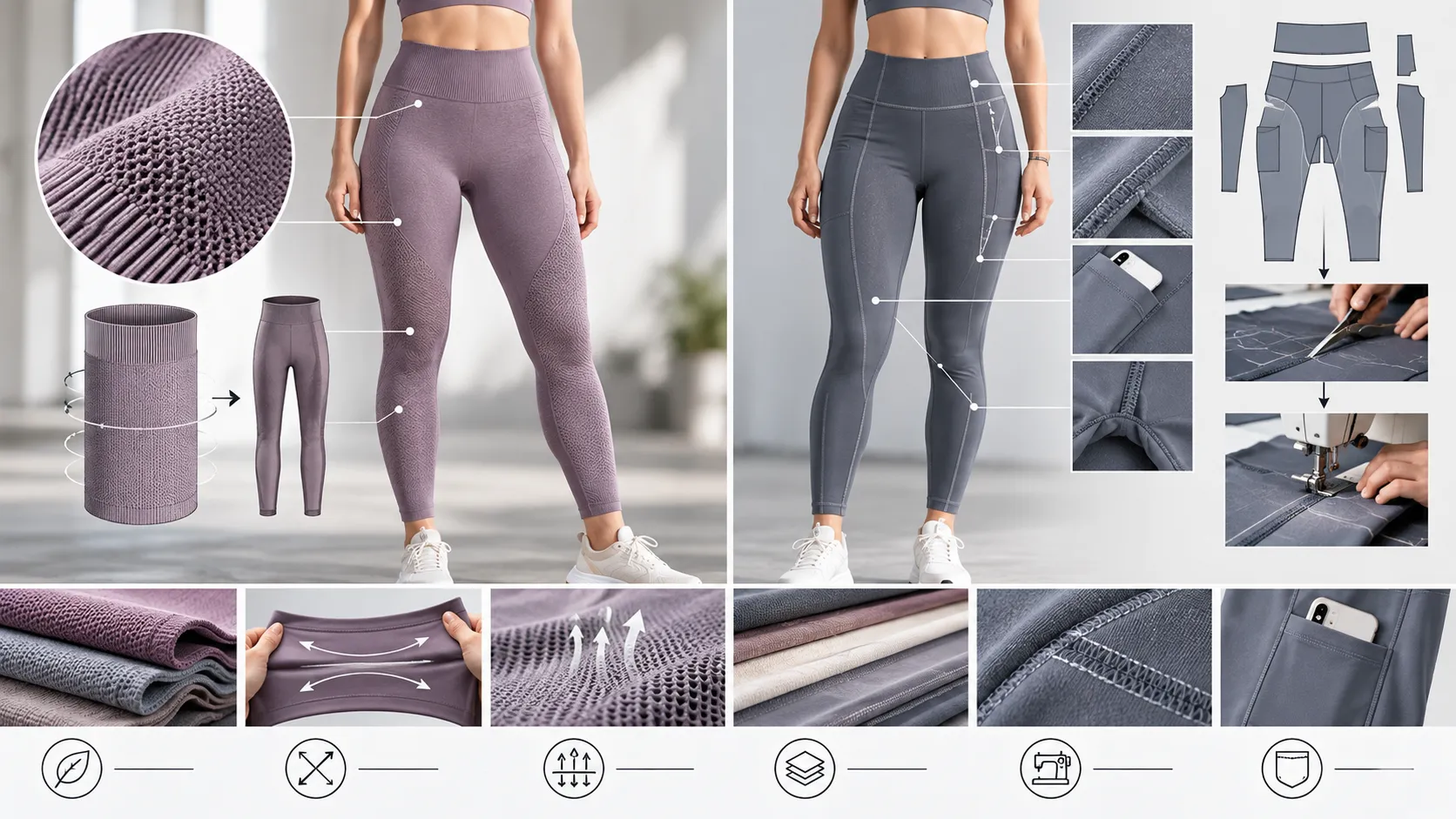
Before requesting a quote, document the target body zone, support level, stretch direction, fabric or yarn preference, artwork, trims, size range, expected quantity, test requirements, and launch date. Ask for a method recommendation with reasons, then compare the sample against movement, opacity, recovery, wash behavior, and construction comfort.
Why Xuanfei can support either route
Xuanfei’s yoga clothing collection shows a seamless-led activewear range, while the company’s published OEM process also covers cutting, sewing, quality control, packaging, and logistics. The combination matters for brands that need one partner to develop a seamless legging, a cut-and-sew pocketed short, and coordinated tops within the same collection.
Xuanfei describes OEM and ODM support, sampling, fabric or yarn recommendations, and quality checks as part of its service. For a technical seamless concept, its published discussion of engineered knit structures provides useful context; for cut-and-sew styles, the same review should focus on pattern accuracy, seam quality, component compatibility, and finishing. The safest sourcing conversation is style by style, with both routes evaluated against the same brief.
Xuanfei’s manufacturing background and its published technical discussion of seamless comfort can help a buyer prepare questions, but final performance should be confirmed through samples and agreed tests.
Supplier checks before approval
- Fit evidence: Request graded samples or a clear size-set plan, then test movement and recovery on the intended wearer range.
- Construction evidence: Review seam maps, knit-zone maps, pocket and trim details, and the points most likely to rub, curl, or distort.
- Material evidence: Confirm the approved fabric or yarn, stretch and recovery targets, opacity, color standard, and wash-care expectations.
- Cost evidence: Separate development, sampling, trims, programming or pattern work, unit price, packaging, and freight assumptions.
- Schedule evidence: Tie each milestone to artwork, tech-pack, sample, size-set, testing, and production approvals so the launch date is measurable.
Conclusion
Seamless and cut-and-sew yoga wear solve different design problems. Seamless is compelling when the brand needs a close fit, low-friction movement, zoned stretch or compression, and integrated knit texture. Cut-and-sew is compelling when the product depends on panel control, pockets, prints, linings, trims, or mixed materials. The strongest assortment may use both. Xuanfei’s ability to work with seamless and cut-and-sew briefs lets the brand choose construction by product purpose instead of by factory bias. Share the tech pack, target materials, quantity, size range, and launch date with the Xuanfei technical team to request a method and fit check.
FAQs
Is seamless yoga wear always more comfortable?
No. Fewer seams can reduce friction, but comfort also depends on yarn or fabric, pressure, recovery, fit grading, and finishing. A well-built cut-and-sew garment can be comfortable when seams and components are placed carefully.
Which method gives stronger compression?
Neither method wins by default. Seamless compression is engineered through knit structure and yarn choices; cut-and-sew compression is built through fabric power, panels, lining, and elastic. Define the required support zones and verify them on samples.
Which method is better for custom prints?
Cut-and-sew usually offers more freedom for large prints, sublimation, and mixed fabrics. Seamless can still support engineered motifs, jacquard effects, ribs, and mesh when the artwork is adapted to the knitting process.
Can one yoga collection use both methods?
Yes. Many brands use seamless for close-fitting core styles and cut-and-sew for pocketed, layered, or fashion-led pieces. The key is to keep fit, color, testing, and quality standards consistent across the range.


